
High cholesterol is the quiet one. No pain, no warning, no symptom you can point to, until a report flags it or, worse, until it shows up as chest trouble years later. Plenty of people who reach our clinic were handed a statin, told to "watch their diet," and left wondering whether that was really the whole answer. Ayurveda looks at the problem differently. It treats high cholesterol not as a number to suppress but as a sign that fat metabolism has gone off course, and it works on that root. Here's what the evidence says, which therapies and herbs are used, and where Ayurveda fits alongside your cardiologist.
TL;DR: Ayurveda treats high cholesterol as a disorder of Meda (fat tissue) and weak digestive fire, not just a lab value. An ICMR-INDIAB study found 79% of Indians had at least one lipid abnormality. Therapies like Lekhana and herbs such as Guggul, which lowered total cholesterol by about 11% in Indian trials, target the cause, alongside, not instead of, prescribed treatment.
How widespread is high cholesterol in India?
Startlingly widespread. The ICMR-INDIAB study, one of India's largest, found that 79% of people studied had at least one abnormal lipid value, and low HDL (the protective cholesterol) was the single most common problem at 72.3% (ICMR-INDIAB study, PLOS One). This isn't a rare condition. It's closer to the norm.
Break it down and the picture sharpens. About 13.9% had high total cholesterol, 29.5% had high triglycerides, and 11.8% had high LDL, with Tamil Nadu showing the highest hypercholesterolemia rate at 18.3%. Indians also tend toward a particular pattern: low HDL with high triglycerides, often tied to refined carbohydrates, sedentary routines and central weight gain. That combination is exactly what Ayurveda would call a Kapha and Meda problem.
How does Ayurveda view high cholesterol?
Ayurveda doesn't have a word for "cholesterol," but it has a precise model for what goes wrong. High blood lipids map closely to Medoroga, a disorder of Meda dhatu (fat tissue), driven by weak digestive fire (Agni), accumulated Ama (metabolic residue), and aggravated Kapha. In short, the body isn't processing fat cleanly, so it lingers in the wrong places.
Why does that framing help you? Because it explains why diet and digestion sit at the centre of treatment, not at the edge. When Agni is strong, fat is metabolised and used. When it's sluggish, the same food turns into Ama and excess Meda, and no amount of willpower at the dinner table fully fixes a metabolism that isn't burning properly. So Ayurvedic treatment rebuilds the metabolism first, then clears what's already accumulated, rather than only blocking one enzyme in the liver.
Which Ayurvedic treatments lower cholesterol?
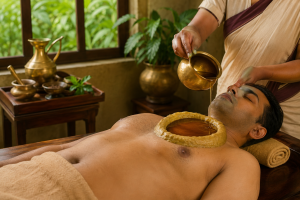
The core strategy is Lekhana, a scraping or depleting approach that reduces excess Meda and Kapha. In practice that combines internal herbal formulations, targeted Panchakarma like Virechana (therapeutic purgation) and Udvartana (a dry herbal-powder massage that mobilises fat), plus a firm diet and movement plan. It's metabolic housekeeping, done methodically.
The herb with the most research behind it is Guggul (Commiphora mukul). Its guggulsterones appear to nudge fat metabolism in the liver. In Indian clinical trials, guggulipid lowered total cholesterol by around 11% and triglycerides by roughly 12 to 17% over 12 to 24 weeks, with one randomised study also showing LDL falling about 12.5% (JAMA, 2003). We pair Guggul-based formulations with Udvartana and diet, because the herb works best as part of a metabolic reset, not as a standalone pill.
One honest note, because trust matters more than hype. A well-known 2003 US trial found guggulipid did not lower LDL in people eating a typical Western diet, and a few participants saw LDL rise. The likeliest explanation is diet and dose. Guggul seems to perform better alongside the lighter, plant-forward eating it was traditionally used with. We'd rather you know that than expect a miracle from a capsule.
Which herbs help manage cholesterol?
Several classical herbs support healthy lipids, each in a slightly different way. None is a substitute for a proper plan, but together, and matched to your constitution, they earn their place.
| Herb (Sanskrit / botanical) | What the research suggests | Traditional role |
|---|---|---|
| Guggul (Commiphora mukul) | Lowered total cholesterol ~11% and triglycerides in Indian trials; mixed on Western diets | Classic Lekhana herb for Medoroga |
| Arjuna (Terminalia arjuna) | Studied for cardiac support and improved lipid profile | Heart-protective bark |
| Triphala | Studied for lipid and weight benefits via better digestion | Gentle detox and Agni support |
| Vrikshamla (Garcinia) | Hydroxycitric acid studied for fat metabolism and appetite | Supports weight and Meda balance |
| Medohar Guggulu | Compound formula combining Lekhana herbs | Reduces excess Meda and Kapha |
Notice what's missing from that list: a single magic herb. Cholesterol responds to the whole package, digestion, diet, movement and the right formulation together. Self-prescribing Guggul off a shelf, especially if you're already on medication, is exactly the kind of shortcut that disappoints people. High cholesterol also rarely travels alone; if your blood pressure is up too, see [INTERNAL-LINK: Ayurvedic treatment for hypertension in Karnataka → sibling article, link once published].

What does cholesterol care look like at Chithrakoota?
We don't hand out a generic "cholesterol package." Care starts by reading your metabolism: your dosha balance, digestion, weight pattern, stress, sleep and current lipid reports. From there we build a plan that usually blends Lekhana therapy, Udvartana, in-house herbal formulations, a corrective diet and daily movement, then we recheck the numbers rather than guess.
Here's where a residential setting earns its keep. Founded in 2010, our 18-acre campus in Udupi district grows more than 150 medicinal plants and runs its own farm and pharmacy. Patients eat warm, freshly cooked, fibre-rich meals tuned to their constitution, start the day with guided yoga, and step away from the office snacking and late dinners that quietly drive lipids up. Change the inputs for a few weeks while the therapy clears what's already there, and the body's fat metabolism finally gets room to recalibrate. That immersion is hard to copy at home, and it's often the part that moves the numbers.
Can Ayurveda replace my statin?
Honest answer: not on your own, and not overnight. If you've already had a cardiac event, or your risk is high, statins are protective and you shouldn't stop them based on a blog. Ayurveda's strength is the upstream work, fixing the metabolism so your lipids trend down and stay down, which over time, under medical supervision, may reduce how much medication you need.
Please read this carefully. Don't stop or reduce a prescribed statin or other heart medication on your own. Keep getting your lipid panel checked on schedule, and let any change happen gradually with your treating doctor watching the numbers. Treat Ayurveda as working with your cardiac care, not as a replacement for it.
Think of it as two jobs. Medication manages immediate risk and keeps you safe. Ayurveda works on the terrain, digestion, weight, Meda and Kapha, so the cause eases rather than just the symptom. Used sensibly together, they cover ground that neither does fully alone.
Frequently asked questions
How long does Ayurvedic treatment take to lower cholesterol?
Lipids move slowly. Clinical trials on Guggul ran 12 to 24 weeks before showing meaningful change, so expect a few months of consistent herbs, diet and movement, with a repeat lipid panel to confirm progress. Quick fixes rarely last, because the underlying metabolism needs time to reset.
Is Guggul safe to take with my statin?
It should only be combined under supervision. Guggul can interact with some medications and isn't suitable in certain conditions, so tell your Ayurvedic doctor exactly what you take. Never start it on your own alongside prescription drugs, and keep monitoring your liver and lipid reports as advised.
Can diet alone fix high cholesterol the Ayurvedic way?
Diet is powerful but rarely the whole answer, especially when 79% of Indians already show a lipid abnormality. Ayurveda pairs a corrective diet with herbs, therapy and movement, because weak digestion (Agni) is often the hidden driver. Fix digestion and diet together and the results hold far better.
I have no symptoms. Why treat high cholesterol at all?
Because high cholesterol is silent until it isn't. It quietly raises the risk of heart attack and stroke over years. Ayurveda treats it as Medoroga, a metabolic imbalance worth correcting early, so you're lowering long-term risk rather than waiting for a warning that may come too late.
Will the cholesterol come back if I stop treatment?
If the old habits return, yes. The whole point of the Ayurvedic approach is lasting change in diet, digestion and routine, not a temporary dip. Patients who keep the dietary and lifestyle gains, and check their lipids periodically, tend to hold their improvement far better than those who treat and forget.
The bottom line
High cholesterol isn't just a number to chase down. It's a signal that fat metabolism needs attention. Statins manage the risk; Ayurveda works on the cause, and the two together beat either one alone.
- 79% of Indians studied had at least one lipid abnormality, with low HDL the most common (ICMR-INDIAB).
- Ayurveda treats it as Medoroga, a disorder of fat tissue, weak Agni and Kapha.
- Guggul lowered total cholesterol around 11% in Indian trials, working best with a light diet.
- It complements statins and lipid testing; it doesn't replace them.
Want to know whether your lipid pattern is a good fit for Ayurvedic treatment? Bring your latest report and let's read it properly. Book a consultation with Chithrakoota Ayurveda, or call +91-9480011578 / message us on WhatsApp, and we'll give you an honest plan for healthier numbers.
Medical disclaimer: This article is for general education and isn't a substitute for personalised medical advice. High cholesterol affects your heart risk. Don't change or stop any prescribed medication without your treating doctor, and keep your lipid panels up to date. Always consult a qualified Ayurvedic physician before starting Panchakarma or herbal treatment.
About the authors: This article was written by Dr. Rajesh Bayari (BAMS), Chief Physician and co-founder of Chithrakoota Ayurveda, and medically reviewed by Dr. Anulekha Bayari (BAMS), Physician and co-founder. Dr. Rajesh holds his BAMS from ALN Rao Memorial Ayurvedic Medical College, Koppa, and together they have run Chithrakoota, an 18-acre Ayurvedic treatment centre in Udupi district, Karnataka, since 2010.