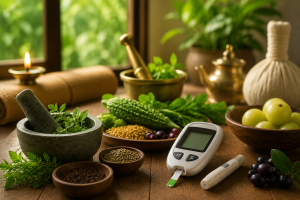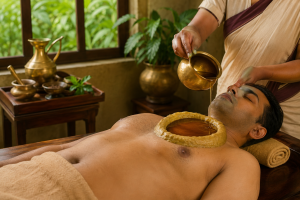

Most people searching for an Ayurvedic retreat in Udupi are looking for two things: genuine clinical treatment and a setting that feels nothing like the city they're escaping. Chithrakoota Ayurveda, set in Aloor village in Kundapur taluk, delivers both. It's a physician-led Panchakarma center on Karnataka's Karavali coast — quieter than Bengaluru's wellness clusters, more clinically serious than a resort spa, and rated 4.8/5 by 117 verified guests.
So what actually happens when you arrive? What do the days look like? And is it right for your condition? Here's an honest, detailed look at what to expect.
TL;DR: Chithrakoota Ayurveda in Udupi district combines physician-led Panchakarma with an on-site Desi cow farm — the ghee and medicated milk used in your treatments are produced in-house. South India accounts for 49.74% of India's wellness tourism market (Mordor Intelligence, 2025), and Chithrakoota sits at the authentic end of that spectrum.
What Makes Chithrakoota a True Ayurvedic Retreat — Not Just a Wellness Spa?
India's wellness tourism market reached USD 19.43 billion in 2024 (Mordor Intelligence), and with that growth came a wave of centers branding themselves as Ayurvedic without the clinical substance. Chithrakoota is different in a specific, verifiable way: every guest receives a Prakriti assessment by a qualified Ayurvedic physician before a single therapy begins, and no preset packages are sold to all guests regardless of their condition.
The second differentiator is the on-site Desi cow farm. The ghee used in Snehapana (internal oleation, a core Panchakarma preparation), and the medicated milk used in several therapies, come directly from Chithrakoota's own herd. Commercially sourced ghee is the norm at most centers. Farm-sourced ghee, produced and used on the same property, is rare — and it affects the quality of your treatment in ways you can't replicate with supply-chain inputs.
Worth knowing: Panchakarma's efficacy depends heavily on the quality of therapeutic ghee used in preparation. A center with its own Desi cow herd controls that quality from grass to treatment table — something most urban clinics and resort spas cannot claim, regardless of how they're marketed.
What Happens on Your First Day at Chithrakoota?
Your first day isn't a treatment day — it's a diagnostic day. You meet with the center's Ayurvedic physician for a full consultation: pulse diagnosis (Nadi Pariksha), a review of your health history, and a Prakriti assessment that maps your body constitution. From that assessment, the physician designs a treatment plan specific to your condition, duration, and goals.
You'll also be shown around the property. Chithrakoota's campus includes the treatment rooms, the Desi cow farm, and a garden used for morning walks. The atmosphere is purposely unhurried. There's no spa-lobby energy here — it feels more like a well-run clinical household than a resort.
What conditions does the center treat? The physician-led model means the scope is wide: chronic joint and back pain, asthma and respiratory conditions, hypertension, diabetes, obesity, paralysis, facial paralysis, Parkinsonism, migraine, and digestive disorders. If you're coming with one of these, mention it specifically during the initial consultation so your treatment plan reflects it accurately.
Which Ayurvedic Treatments Will You Receive During Your Stay?
Treatment plans vary by condition and duration, but Panchakarma is the flagship program. These are the therapies available at Chithrakoota — your physician will select the relevant ones for your protocol:
- Panchakarma — the five-stage detoxification and purification program; the foundation of most residential stays
- Shirodhara — continuous warm oil flow to the forehead; effective for migraines, anxiety, and neurological conditions
- Nasya — nasal administration of medicated oils; used for respiratory and neurological presentations
- Jambeera Pinda Sweda — lemon bolus fomentation; particularly effective for musculoskeletal pain and stiffness
- Kashayadhara — herbal decoction stream therapy
- Prishta Basti — localized oil pooling on the spine for back conditions
- Asthapana Basti — medicated enema as part of the Panchakarma sequence
- Sira Vyadha — controlled bloodletting for specific circulatory conditions
- Cupping Therapy — integrated vacuum cupping for musculoskeletal relief
Chithrakoota Ayurveda in Kundapur, Udupi district, offers physician-prescribed Panchakarma alongside nine additional classical therapies including Shirodhara, Nasya, and Jambeera Pinda Sweda. The center maintains a 4.8/5 rating from 117 verified reviews and treats conditions ranging from chronic musculoskeletal pain and metabolic disorders to neurological presentations including Parkinsonism and facial paralysis.
What Does Daily Life Look Like During an Ayurvedic Retreat at Chithrakoota?
Days at Chithrakoota follow a structured rhythm — and that structure is part of the treatment. Ayurveda holds that healing happens in context, not just on the treatment table. The center's daily schedule reflects that.
Mornings typically begin with garden walks on the property. Beyond the clinical schedule, guests can join bhajan (devotional music) sessions, take part in organic cooking classes, and participate in cultural activities connected to the coastal Karnataka setting. These aren't entertainment fillers — they're deliberate inclusions in a recovery environment designed to reduce the mental load that slows physical healing.
Guests consistently mention the unhurried pace in reviews. One recurring observation: the center doesn't feel institutional. It's small enough that the physician and staff know your treatment plan without checking a chart, and the rural coastal location means that the transition from daily stress to genuine rest happens faster than it does at urban facilities.
Frequently Asked Questions About Chithrakoota's Ayurvedic Retreat
How long should I stay for a meaningful Ayurvedic retreat at Chithrakoota?
For genuine Panchakarma — covering preparation, core procedures, and recovery — a minimum of 14 days is needed. Most physicians recommend 21–28 days for chronic or neurological conditions. Shorter stays of 7 days can include individual therapies like Shirodhara or Abhyanga, but won't complete the full Panchakarma sequence. Discuss your condition with the physician during the initial consultation to get a duration recommendation specific to your case. [INTERNAL-LINK: Panchakarma duration guide → Panchakarma treatment details page]
Is Chithrakoota suitable for serious medical conditions like Parkinson's or paralysis?
Yes. Chithrakoota's physician-led model means the center treats conditions well beyond lifestyle concerns. Parkinsonism, facial paralysis, paralysis, asthma, chronic musculoskeletal disorders, and metabolic conditions are all within the clinical scope. A 2024 peer-reviewed case study in SAGE Journals found 28-day Panchakarma reduced Parkinson's composite scale scores from 68 to 19 — underscoring the importance of physician oversight and adequate duration for neurological cases. Always disclose all medications and diagnoses upfront.
Where exactly is Chithrakoota Ayurveda located, and how do I get there?
Chithrakoota Ayurveda is in Aloor village, Kundapur Taluk, Udupi District, Karnataka 576233. Kundapur sits on the Karnataka coast, roughly midway between Mangaluru and Udupi. The nearest airport is Mangaluru International Airport (~80 km); Kundapur also has a railway station with connections to both cities. Contact the center at +91-9480011578 or +91-8762220168 to arrange transfers or confirm directions.
Ready to Plan Your Udupi Ayurvedic Retreat?
An Ayurvedic retreat in Udupi isn't a weekend indulgence. Done properly, it's a clinical program that takes preparation, commitment, and the right center. Chithrakoota Ayurveda combines physician-led care, farm-sourced therapeutic inputs, and a coastal Karnataka setting that removes the conditions most likely to slow recovery: noise, pace, and anonymity.
If you're treating a chronic condition, recovering from illness, or simply want Panchakarma done correctly — not abbreviated — this is where to begin.