Here's a number worth sitting with: according to NFHS-5 (2019-21), 24% of Indian men and 25% of Indian women are now overweight or obese. The [ICMR-INDIAB study]went further in 2023, estimating that abdominal obesity affects nearly 40% of Indians. The belly, as our grandmothers would say, arrives before the disease does.
Most people fight this with crash diets and gym memberships that fizzle out by March. The weight returns, often with interest. Why? Because obesity isn't just extra food — it's a disturbed metabolism, and a disturbed metabolism doesn't respond to punishment. It responds to correction.
That correction is precisely what Panchakarma was designed for. At Chithrakoota Ayurveda in Aloor, Kundapur (Udupi district, Karnataka), our physician-led Panchakarma programs treat obesity as the metabolic disorder Ayurveda calls Sthoulya — and the results tend to last longer because the method goes deeper.
Quick summary:
- Ayurveda treats obesity (Sthoulya) as a Kapha-Meda disorder driven by weak metabolism, not just overeating.
- Panchakarma for obesity typically combines Udwarthana, Swedana, Virechana and Lekhana Basti.
- Residential programs run 14 to 28 days, with diet and daily routine built into the treatment.
- The goal is corrected metabolism and sustained results, not rapid-loss numbers that bounce back.
Why Does Ayurveda Treat Obesity Differently?
Ayurveda's texts describe Sthoulya with surprising precision: excess Kapha dosha and malformed Meda dhatu (fat tissue) accumulating because the digestive fire (Agni) at the tissue level has weakened. Notice what that implies. The obese body is often an under-nourished body — food gets converted to fat but not to strength, which is why many overweight people feel constantly tired and hungry at the same time.
So the Ayurvedic strategy isn't starvation. Starving actually aggravates Vata and drops metabolism further, which is exactly what happens after most crash diets. The strategy instead is threefold: scrape away accumulated fat and Ama (metabolic waste), rekindle tissue-level metabolism, and rebuild eating and sleeping patterns so the correction holds.
Which Panchakarma Therapies Are Used for Obesity?
Panchakarma is a sequence, not a single procedure. For Sthoulya, our doctors typically build the program from these therapies:
Udwarthana — herbal powder massage
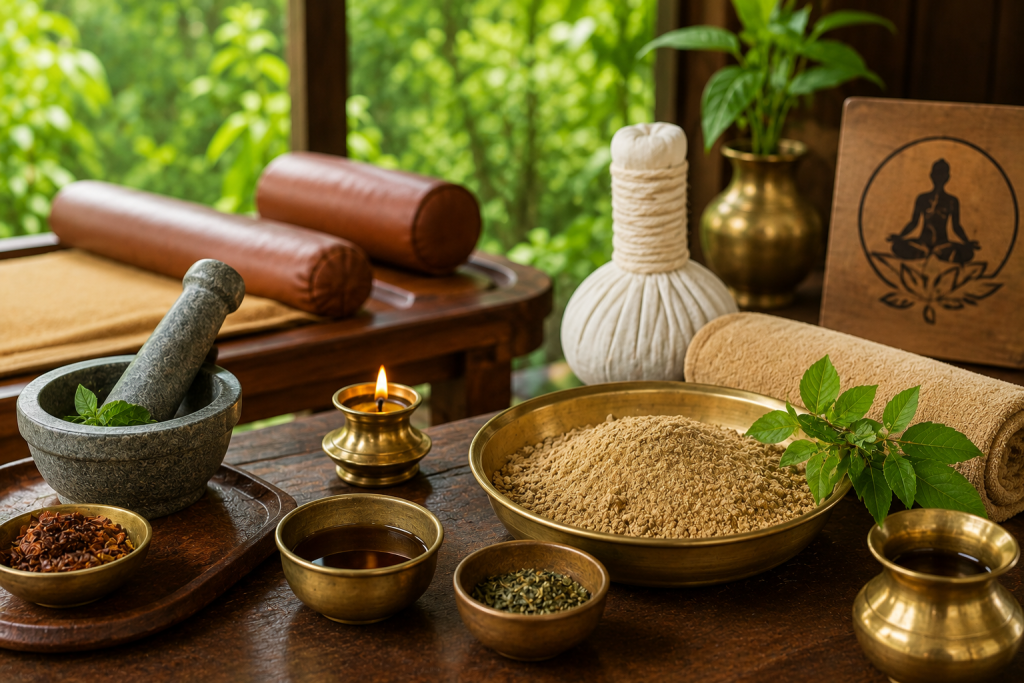
The signature obesity therapy. Therapists massage warm herbal powders like Kolakulathadi churna over the body in firm upward strokes, working on subcutaneous fat and Kapha directly. We've covered this therapy in detail in our separate guide to Udwarthana for weight loss.
Swedana — herbal steam therapy
Medicated steam liquefies accumulated Kapha and Meda, opens the channels and preps the body for elimination therapies. Sweating you can actually feel working.
Vamana — therapeutic emesis
For patients with dominant Kapha, supervised therapeutic vomiting removes the excess at its seat. It sounds intense, and our doctors perform it only after days of preparation, only for those fit for it.
Virechana — therapeutic purgation
A physician-controlled cleanse of the gut that clears Pitta and Kapha, resets digestion and often produces the first visible drop in weight and bloating.
Lekhana Basti — scraping medicated enema
A specialised series of medicated enemas with "scraping" (lekhana) herbs that act on fat tissue. Classical texts consider Basti the most important of all therapies, and for stubborn abdominal obesity it earns that reputation.
Nobody receives all of these. Your physician selects and sequences the right ones after assessing prakriti, strength, age and existing conditions like thyroid disorders, PCOD or diabetes— all frequent companions of weight gain.
What Results Can You Realistically Expect?
Let's keep this honest, because weight loss marketing rarely is. During a 14 to 28 day residential program, most guests see measurable reductions in weight, waist circumference and bloating, along with better energy, sleep and digestion. Published Ayurvedic clinical work, including reviews of Udvartana therapy in Sthoulya, has reported meaningful improvements in BMI and lipid profiles when therapies like Udwarthana combine with internal medicines and diet.
But the real product isn't the kilos dropped in-house. It's what happens after. Because Panchakarma corrects digestion and food behaviour together, guests routinely find the loss continues at home for months — provided they follow the discharge plan. Anyone promising "lose 15 kg in 15 days" is selling dehydration, not medicine.
What Makes the Chithrakoota Program Different?
Location does some of the work. Our 18-acre campus at Kundapur, with over 150 medicinal plants, a desi cow farm and solar-powered facilities, removes you completely from the environment that produced the weight — the late-night fridge, the delivery apps, the desk.
The rest is structure:
- Physician-led, not package-led: Your program is designed after examination, not picked from a rate card.
- In-house medicines: Powders, oils and decoctions prepared in our own pharmacy, largely from campus-grown herbs.
- Kitchen as dispensary: Kapha-reducing meals — millets, barley, warm vegetables, buttermilk — cooked from our farm produce and timed to your treatment.
- Daily yoga and walking: Morning yoga sessions and garden walks are scheduled, not suggested.
- A written take-home plan.** Diet, routine and follow-up reviews, so the correction survives contact with real life.
Frequently Asked Questions
How much weight can I lose with Panchakarma?
It varies with your starting weight, program length and metabolism. Most guests on a 21-day program see steady, visible reduction along with a smaller waistline and less bloating. Ayurveda deliberately avoids rapid-loss targets — the aim is fat reduction that holds, not water weight that returns in a fortnight.
Is Panchakarma for obesity painful or harsh?
No. Therapies like Udwarthana and Swedana are vigorous but comfortable. Cleansing procedures like Virechana are physician-supervised, preceded by days of preparation, and adjusted to your strength. Most guests describe the experience as demanding in discipline, not in discomfort.
Can I take Panchakarma if I have thyroid issues, PCOD or diabetes?
Usually yes — these conditions often accompany obesity, and the program is adjusted around them. Our physicians review your reports and medications first, and your existing prescriptions continue during treatment. Certain therapies are modified or skipped based on your condition.
How long should I stay at Chithrakoota for obesity treatment?
A minimum of 14 days is recommended for genuine Panchakarma; 21 to 28 days suits higher body weights or when Vamana and Basti courses are included. Shorter wellness stays help, but full metabolic correction needs the complete sequence.
Stop Dieting. Start Correcting.
If the weight keeps returning no matter what you try, the problem probably isn't your willpower — it's your metabolism. Let our physicians at Chithrakoota Ayurveda, Aloor, Kundapur (Udupi district, Karnataka) assess it properly and design a Panchakarma program around you.
Call +91-94800 11578 or +91-87622 20168, or reach us on WhatsApp to plan your stay.


