
Breathing is supposed to be the one thing you never have to think about. For millions of people across Karnataka and the rest of India, it isn't. A tight chest at 3 a.m., a wheeze that comes back every monsoon, an inhaler that lives in your bag but never quite settles things. That's the everyday reality of asthma. Conventional inhalers manage the symptom well. The question patients keep asking is a different one: can anything calm the underlying tendency? Ayurveda has worked with this exact pattern for centuries, and it has a name for the condition: Tamaka Shwasa. A growing body of clinical research is now testing those methods. Here's what the evidence shows, what the therapies involve, and how we approach asthma at Chithrakoota.
TL;DR: Ayurveda treats asthma (Tamaka Shwasa) by clearing excess Kapha and steadying Vata, not only by widening the airways during an attack. India carries an estimated 34.3 million asthma cases (Global Burden of Disease, 2019), and much of it stays under-treated. A personalised plan of Panchakarma, herbs such as Vasa, diet and breathing work can cut down flare-ups, working alongside (never instead of) your prescribed medication.
How common is asthma in India, and why is so much of it under-treated?
India has roughly 34.3 million people living with asthma, about 13% of the world's cases, yet the country shoulders a far heavier share of global asthma deaths (Global Burden of Disease, 2019). That gap isn't only biology. It's diagnosis, follow-through, and a quiet fear of taking daily medication.
Look at the older national numbers and the same story shows up. The ICMR-backed INSEARCH study put the adult asthma burden at 17.23 million, with prevalence swinging from 0.4% in Secunderabad to 4.8% in Kolkata. When the rate jumps more than tenfold between cities, you're not looking at a purely genetic disease. You're looking at air, climate, dust, and how people live.
The treatment gap is the part that bothers us most. A nationwide study under the Global Asthma Network found that under-diagnosis and under-treatment are widespread, even among people with clear, severe symptoms. Many patients reach for an inhaler only during an attack, then put it away. Nobody addresses the body that keeps producing the attacks in the first place. That's precisely where an Ayurvedic approach starts.
How does Ayurveda understand asthma (Tamaka Shwasa)?
Ayurveda classifies bronchial asthma as Tamaka Shwasa, a disorder driven mainly by aggravated Kapha and Vata doshas settling in the chest. In plain terms: sticky congestion (Kapha) narrows the channels, and erratic movement (Vata) triggers the spasm and the gasping. Treat both, and the attacks lose their fuel.
This is the real difference in thinking. A reliever inhaler relaxes the airway muscle for a few hours. Genuinely useful, and we never argue with that. Ayurveda asks a slower question: why is this chest so reactive in the first place? Weak digestion (Agni), accumulated Ama (metabolic residue), cold and damp food, and a sluggish respiratory channel all feed the pattern. So the plan targets the terrain, not just the moment of crisis. Root-level correction is the goal; symptom relief is the welcome by-product.

Which Ayurvedic treatments are used for asthma?
Ayurvedic asthma care runs on three gears: Shodhana (cleansing the excess Kapha through Panchakarma), Shamana (calming herbs and formulations), and Rasayana (rebuilding strength so flare-ups don't return). For a Kapha-heavy chest, the central Panchakarma procedure is Vamana, a carefully supervised, medicated emesis that clears the congestion at its source.
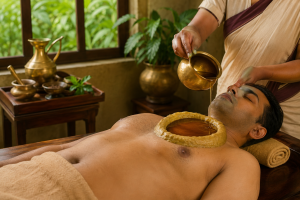
That word makes people nervous, so let's be plain about it. Vamana isn't something you do at home, and it isn't unpleasant when done right. It's preceded by days of internal and external oleation (Snehana) and steam (Swedana) to loosen the Kapha first, then conducted under direct supervision. In our experience at Chithrakoota, patients whose asthma is clearly Kapha-dominant (heavy mucus, worse in cold and damp) tend to respond best to this route, often reporting lighter breathing and fewer night-time episodes within the weeks that follow.
In Ayurvedic practice, Vamana is the classical Shodhana for Kapha-dominant asthma. Clinical studies on Tamaka Shwasa report meaningful reductions in cough, chest heaviness and disturbed sleep, plus improved quality-of-life scores, after a properly conducted Vamana course (Journal of Ayurveda and Integrated Medical Sciences). Where the patient is more Vata-dominant or too weak for emesis, Virechana (therapeutic purgation) and gentler Shamana therapy take the lead instead.
For day-to-day relief between or instead of cleansing, we lean on Nasya (medicated nasal therapy) to clear the upper channel, steam with respiratory herbs, and targeted oral formulations. You can see the full range of Panchakarma procedures we run on our treatments page. If your trouble is more sinus and post-nasal drip than wheeze, Nasya deserves a closer look: [INTERNAL-LINK: Nasya therapy for sinusitis and respiratory problems → sibling article, link once published].
Which Ayurvedic herbs support easier breathing?
Several classical respiratory herbs now have laboratory or clinical work behind them. Vasa (Adhatoda vasica) is the headline act: its alkaloids vasicine and vasicinone show genuine bronchodilator, expectorant and anti-inflammatory activity, which is why it appears in so many cough and asthma formulas. Herbs aren't a stand-alone cure, but as part of a structured plan they earn their place.
| Herb (Sanskrit / botanical) | What the research suggests | Traditional respiratory role |
|---|---|---|
| Vasa (Adhatoda vasica) | Vasicine & vasicinone show bronchodilator, mucolytic and expectorant action | Loosens and clears stubborn chest congestion |
| Pushkarmool (Inula racemosa) | Studied for bronchodilation and easing chest tightness | Classic herb for Shwasa and chest pain |
| Tylophora (Tylophora indica) | Early double-blind trials showed symptom relief; later trials were mixed (promising, not proven) | Traditional anti-asthmatic leaf |
| Yashtimadhu (Glycyrrhiza glabra) | Demulcent and anti-inflammatory; soothes irritated airways | Calms dry, irritable cough |
| Haridra (Curcuma longa) | Curcumin's anti-inflammatory effect studied in allergic airway inflammation | Reduces allergic reactivity over time |
One honest caveat, because it matters. Tylophora is often sold as a miracle asthma leaf. The early 1970s double-blind studies did show relief, but several later, better-designed trials reported mixed results. We'd rather tell you that than oversell it. The herbs we choose, and the doses, depend on your constitution and the stage of your disease. That's exactly why self-prescribing from a list is the wrong move.
What does asthma care look like at Chithrakoota?
No two asthmatic chests are alike, so we don't run a fixed package. Care begins with a detailed consultation: your dosha balance, triggers, digestion, sleep, and how your asthma behaves across the seasons. From there we build a plan that may combine Panchakarma, in-house herbal formulations, diet correction, and daily pranayama. Founded in 2010, our centre sits on an 18-acre campus in Udupi district, Karnataka, with more than 150 medicinal plants grown on site.
Why does the campus matter to your lungs? Because a lot of asthma care is environmental. Patients stay in clean coastal Karnataka air, eat warm sattvic food cooked with farm-fresh produce and our own desi-cow ghee, start the morning with guided yoga, and take medicines made fresh in our pharmacy rather than off a shelf. Remove the cold, the damp, the processed food and the city dust for a few weeks, layer the therapy on top, and the body finally gets a chance to reset. That combination is hard to reproduce at home, and it's the part patients tell us made the difference.

Can Ayurveda replace your inhaler?
Honest answer: not as a switch you flip overnight, and never on your own. Asthma is a condition where a severe attack can be life-threatening, and a rescue inhaler can save your life in minutes. Ayurveda's strength is the longer game: reducing how often and how hard you flare, so over time some patients, under medical supervision, find they need their reliever far less.
Please read this carefully. Don't stop or cut your prescribed controller or reliever medication on your own. Any change should happen gradually, with your treating doctor watching your symptoms and lung function. Think of Ayurveda as working with your respiratory care, not as a replacement for emergency treatment.
The right way to picture it is two hands doing different jobs. Modern medicine handles the acute attack and keeps you safe. Ayurveda works on the terrain (digestion, immunity, Kapha, resilience) so the attacks come less often. Used together, sensibly, they cover what neither does alone.
Frequently asked questions
Is Ayurvedic asthma treatment safe to take alongside my inhaler?
Yes, when it's supervised. Asthma is widely under-treated in India even among people with severe symptoms (Global Asthma Network), so adding a root-cause approach helps. But tell your Ayurvedic doctor every medication you take so the plan is coordinated, not conflicting. Keep your reliever inhaler with you throughout.
How long before I notice a difference?
It varies with how long you've had asthma and how Kapha-dominant it is. Many patients notice lighter breathing and fewer night-time episodes within a few weeks of starting therapy, while lasting change in flare-up frequency usually needs a few months of consistent treatment, diet and breathing practice.
Is Vamana therapy painful or risky?
Done correctly, it's controlled and well tolerated, not an ordeal. Several days of oleation and steam prepare the body first, and the procedure itself is fully supervised. It isn't suitable for everyone. The very weak, the elderly, or certain Vata-type patients are guided toward gentler options like Virechana or Shamana instead.
Why does my asthma get worse during the monsoon?
Cold, damp weather aggravates Kapha, the very dosha behind Tamaka Shwasa, and humidity raises mould and dust-mite exposure. That's why so many patients flare in the rains. Seasonal Ayurvedic routines (Ritucharya) and a pre-monsoon cleanse are designed precisely to blunt that yearly spike.
Can children receive Ayurvedic asthma treatment?
Yes, with age-appropriate, gentler protocols. Children are rarely given aggressive Shodhana. Treatment leans on mild herbs, diet, immunity-building Rasayana and breathing practice. Since childhood asthma is commonly under-treated, a careful Ayurvedic plan can sit usefully beside paediatric care. Always involve your child's doctor.
The bottom line
Asthma doesn't have to run your nights and your monsoons. Inhalers keep you safe in the moment; Ayurveda goes after the reason your chest stays reactive in the first place. The two work better together than either does alone.
- India carries an estimated 34.3 million asthma cases, much of it under-treated (GBD, 2019).
- Ayurveda treats asthma as Tamaka Shwasa, a Kapha-Vata disorder, and targets the root, not just the attack.
- Panchakarma (especially Vamana), herbs like Vasa, diet and pranayama form a personalised plan.
- It complements your inhaler. It doesn't replace emergency medication.
Wondering whether your asthma is Kapha-dominant and a good fit for this approach? The honest way to find out is a proper consultation. Book a consultation with Chithrakoota Ayurveda, or call +91-9480011578 / message us on WhatsApp, and we'll tell you candidly what Ayurveda can and can't do for your case.
Medical disclaimer: This article is for general education and isn't a substitute for personalised medical advice. Asthma can be serious. Don't change or stop any prescribed medication without your treating doctor. Always consult a qualified Ayurvedic physician before starting Panchakarma or herbal treatment.
About the authors: This article was written by Dr. Rajesh Bayari (BAMS), Chief Physician and co-founder of Chithrakoota Ayurveda, and medically reviewed by Dr. Anulekha Bayari (BAMS), Physician and co-founder. Dr. Rajesh holds his BAMS from ALN Rao Memorial Ayurvedic Medical College, Koppa, and together they have run Chithrakoota, an 18-acre Ayurvedic treatment centre in Udupi district, Karnataka, since 2010.