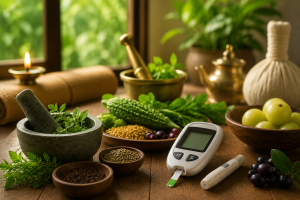

High blood pressure has earned its nickname, the silent killer. It rarely announces itself, yet it quietly strains the heart, kidneys and brain for years. Many people who come to us have just been told their BP is high and handed a daily tablet, and what they really want to know is simple: can I bring this down without depending on medicine forever? It's a fair question, and the honest answer has real nuance. Ayurveda treats high blood pressure as a sign of deeper imbalance in circulation, digestion and, above all, the mind. Here's what the evidence shows, which therapies and herbs are used, and exactly where lifestyle can do the heavy lifting and where medication still matters.
TL;DR: Ayurveda treats hypertension as a Vata, Pitta and stress-driven imbalance, leaning heavily on calming therapies like Shirodhara plus diet and yoga. About 1 in 4 Indian adults has high BP, and barely 1 in 8 has it controlled (ICMR-INDIAB). For mild cases, lifestyle and Ayurveda can lower readings meaningfully, but you should never stop prescribed BP medicine on your own.
How common is high blood pressure in India?
Common, and badly under-controlled. The ICMR-INDIAB study put the age-standardised prevalence of hypertension at 26.3%, which means roughly 1 in 4 Indian adults, and a large share didn't know until they were tested (ICMR-INDIAB study). Among people over 45, prevalence climbs to around 46%.
The control gap is the real scandal. Fewer than half of people with high BP are even aware of it, and by most national estimates barely 1 in 8 has their pressure properly controlled. That's a lot of hearts under quiet strain. It also explains why an approach that tackles the root, stress, diet and circulation, not just the daily number, draws so much interest.
How does Ayurveda understand high blood pressure?
Ayurveda has no single classical disease called "hypertension," but it reads the condition clearly through its own lens: a disturbance of Vata and Pitta affecting Rakta (blood) and circulation, very often set off by the mind. Stress, anger, poor sleep and overwork aggravate Vata and Pitta, the heart and vessels tighten, and pressure rises.
This is why an Ayurvedic plan spends so much energy on calming the nervous system, not only on the vessels. If chronic stress is keeping your pressure up, a vasodilator alone treats the downstream effect while the upstream cause keeps firing. Ayurveda goes after both: it steadies the mind, eases Vata, cools Pitta, and supports the heart and circulation together. For stress-driven hypertension in particular, that mind-first emphasis is the whole point.
Which Ayurvedic therapies lower blood pressure?
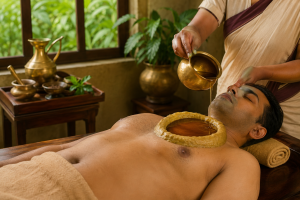
The signature therapy is Shirodhara, a steady stream of warm medicated oil poured over the forehead. It sounds simple, but its effect on the stress response is profound, and that's where much of the blood-pressure benefit comes from. Around it we use diet correction, gentle Panchakarma where suitable, daily yoga and pranayama, and meditation to retrain the stress that drives the readings up.
The research is encouraging for the stress-linked type. A clinical trial on essential hypertension evaluated Shirodhara together with Sarpagandha Vati and found meaningful improvement in patients where psychological factors drove the pressure (Journal of Ayurveda and Integrative Medicine). Shirodhara's strength is that it lowers the stress load behind the numbers, which is exactly the part a tablet doesn't touch. In our experience, it's the patients whose BP spikes with tension and poor sleep who feel the clearest difference.
Which herbs are used for hypertension?
Several herbs support healthy blood pressure, but they sit on very different ends of the safety spectrum, and that distinction matters enormously. Some are gentle daily supports. One, Sarpagandha, is genuinely potent and must be treated like the strong medicine it is.
| Herb (Sanskrit / botanical) | What the research suggests | Traditional role |
|---|---|---|
| Sarpagandha (Rauwolfia serpentina) | Potent; its reserpine lowered SBP/DBP by 10 to 15 mmHg in studies. Prescription-grade, with real side effects | Powerful BP-lowering herb, supervised use only |
| Arjuna (Terminalia arjuna) | Studied for cardiac support and circulation | Heart-strengthening bark |
| Jatamansi (Nardostachys jatamansi) | Studied for calming the nervous system and sleep | Settles aggravated Vata and the mind |
| Brahmi (Bacopa monnieri) | Studied for stress and cognitive calm | Mind tonic, reduces mental tension |
| Ashwagandha (Withania somnifera) | Adaptogen studied for lowering stress hormones | Builds resilience to stress |
About Sarpagandha specifically. It contains reserpine, the same compound once used as a pharmaceutical BP drug, and it can cause depression, sluggishness, nasal congestion and a slowed heart rate. It can also interact dangerously with prescribed medicines. This is not a herb to buy online and self-dose. It should only ever be used under a qualified physician's supervision, with your blood pressure monitored.

Can you really lower blood pressure without medication?
Honest answer: sometimes, and it depends entirely on the stage. For mild, early, stress-driven high blood pressure, lifestyle change, diet, weight loss, exercise, less salt, better sleep, and stress therapy like Shirodhara can lower readings enough that some patients, with their doctor's agreement, end up on little or no medication. That's a real outcome, not a sales pitch.
But, and this matters, it isn't true for everyone. Moderate to severe hypertension, or BP with existing heart or kidney involvement, usually needs medication to stay safe, and stopping it can trigger a stroke. So the realistic goal isn't "throw away your tablets." It's to treat the cause so thoroughly that, if your doctor agrees your numbers and risk allow it, your medication can be reduced safely over time.
Please read this carefully. Never stop or reduce a prescribed blood-pressure medicine on your own. Uncontrolled hypertension can cause stroke, heart attack and kidney damage, often with no warning. Keep monitoring your BP, and let any change happen gradually with your treating doctor deciding, based on your actual readings. Ayurveda works with your cardiac care here, not instead of it.
What does hypertension care look like at Chithrakoota?
Because so much hypertension is stress-driven, our approach starts with the nervous system, not just the vessels. After assessing your constitution, BP history, sleep, diet and stress, we build a plan that often blends Shirodhara, gentle Panchakarma where appropriate, in-house herbal formulations, a low-salt corrective diet, and a daily rhythm of yoga and meditation, then we track the readings rather than assume.
The setting itself lowers blood pressure, which is the quiet advantage of residential care. Founded in 2010, our 18-acre campus in Udupi district is calm coastal Karnataka, no traffic, no inbox, no late dinners. Patients begin the day with guided yoga, eat warm, low-salt, freshly cooked meals from the farm, take medicines made fresh in our pharmacy, and wind down with meditation. Remove the constant stress drip for a few weeks while the therapy does its work, and pressure often eases on its own. That immersion is genuinely hard to recreate at home, and for stress-linked hypertension it's frequently the difference-maker.
Frequently asked questions
Can Ayurveda cure high blood pressure permanently?
"Cure" is the wrong word to promise. For mild, stress-driven cases, Ayurveda and lifestyle change can normalise readings and, with your doctor's agreement, reduce reliance on medication. For established hypertension, the realistic aim is long-term control of the cause, not a permanent guarantee, and ongoing monitoring still matters.
Is Shirodhara actually effective for blood pressure?
For stress-related hypertension, yes, it shows promise. A clinical trial found Shirodhara with Sarpagandha Vati improved essential hypertension where psychological factors were involved. Its benefit comes from calming the stress response that drives readings up, which is why it pairs so well with diet and yoga rather than working in isolation.
Can I take Sarpagandha on my own to lower my BP?
No. Sarpagandha is potent, contains reserpine, and can cause depression, a slowed heart rate and dangerous interactions with prescribed drugs. It must only be used under a qualified physician's supervision with your blood pressure monitored. Self-dosing a strong herb like this is genuinely risky, not a natural shortcut.
How soon might my readings improve?
Stress-linked readings can ease within weeks of consistent Shirodhara, diet and yoga, while lasting change in established hypertension usually takes a few months. Keep measuring your BP throughout, because the readings, not how you feel, are what tell you and your doctor whether it's working.
I also have high cholesterol. Can both be treated together?
Often, yes, and they frequently travel together. Both respond to the same core of diet, weight, stress and digestion that Ayurveda targets, so a single integrated plan can address them at once. See [INTERNAL-LINK: Ayurvedic treatment for high cholesterol in Karnataka → sibling article, link once published] for the lipid side of the picture.
The bottom line
High blood pressure is too common and too dangerous to leave half-treated. Medication keeps you safe; Ayurveda works on the stress, diet and circulation underneath, and for the right patient that combination can mean lower readings and, sometimes, less medicine over time.
- About 1 in 4 Indian adults has high BP, and barely 1 in 8 has it controlled (ICMR-INDIAB).
- Ayurveda treats it as a Vata, Pitta and stress imbalance, leaning on Shirodhara, diet and yoga.
- Mild, stress-driven cases may improve enough to reduce medication, with your doctor's agreement.
- Never stop BP medicine on your own, and treat Sarpagandha as supervised-only.
Want to know whether your blood pressure is the kind that responds well to this approach? Bring your readings and let's talk honestly about what's realistic. Book a consultation with Chithrakoota Ayurveda, or call +91-9480011578 / message us on WhatsApp, and we'll map out a safe, root-cause plan.
Medical disclaimer: This article is for general education and isn't a substitute for personalised medical advice. Uncontrolled high blood pressure can cause stroke, heart attack and kidney damage. Don't change or stop any prescribed medication without your treating doctor, and keep monitoring your BP. Always consult a qualified Ayurvedic physician before starting Panchakarma or herbal treatment, especially potent herbs like Sarpagandha.
About the authors: This article was written by Dr. Rajesh Bayari (BAMS), Chief Physician and co-founder of Chithrakoota Ayurveda, and medically reviewed by Dr. Anulekha Bayari (BAMS), Physician and co-founder. Dr. Rajesh holds his BAMS from ALN Rao Memorial Ayurvedic Medical College, Koppa, and together they have run Chithrakoota, an 18-acre Ayurvedic treatment centre in Udupi district, Karnataka, since 2010.