
If you've lived through a Karnataka monsoon with a blocked nose, you know the routine. Pressure behind the cheeks, a headache that sharpens when you bend down, endless throat-clearing, and antibiotics that work for a fortnight before the congestion creeps back. Sinus trouble is one of the most common reasons people walk into our clinic, and one of the most wearing to live with. Ayurveda has an unusually direct answer for it: Nasya, a medicated nasal therapy that treats the head and sinuses through the one doorway that actually reaches them, the nose. Here's how it works, what the research shows, and who it tends to help.
TL;DR: Nasya delivers medicated oil through the nostrils to clear and heal the sinuses, nasal passages and head. Nearly 1 in 10 Indian adults lives with allergic rhinitis, and about 40% of them also develop asthma (Allergic Rhinitis in India review). One clinical trial found Anu Taila Nasya cut nasal obstruction scores by roughly 35% in four weeks, treating the cause rather than masking it.
What is Nasya therapy, and why the nose?
Nasya is the practice of instilling medicated oil, ghee or herbal extracts into the nostrils. Classical Ayurveda calls the nose the gateway to the head (Nasa hi shiraso dwaram), which means almost anything above the collarbone, the sinuses, the nasal lining, the eyes, even mental fog, can be reached and treated through that single route.
Why does that matter for your sinuses? Because a tablet swallowed into the stomach takes a long detour before any trace of it reaches an inflamed sinus cavity. Oil placed directly into the nasal passage doesn't. It coats the lining, loosens trapped Kapha (the heavy, sticky mucus behind most congestion), calms inflammation, and helps the sinuses drain the way they're meant to. The relief is often local and quick, while the deeper effect builds over a course of sessions.

How common are sinus and nasal problems in India?
Far more common than most people assume. Around 20 to 30% of Indians live with at least one allergic disease, and allergic rhinitis alone makes up roughly 55% of them (Allergic Rhinitis in India review). That's the engine behind a huge share of chronic sinus complaints.
The numbers climb higher in younger people. About 22% of Indian adolescents and close to 9.8% of adults report allergic rhinitis, and allergy shows up in nearly two-thirds of chronic rhinosinusitis patients. The sting in the tail is the asthma link: around 40% of allergic rhinitis cases go on to develop asthma too. Treat the nose early and well, and you may be heading off a bigger respiratory problem down the line.
How does Nasya clear sinusitis at the root?
Ayurveda names chronic sinusitis Dushta Pratishyaya, a long-standing nasal disorder driven mainly by aggravated Kapha clogging the channels of the head. Nasya works by clearing that Kapha at source, draining the stagnant mucus, and restoring normal flow, so the cavities stop becoming a breeding ground for repeat infection.
This is where Nasya separates itself from a decongestant spray. A spray shrinks the lining for a few hours, then wears off, and overuse can actually make rebound congestion worse. Nasya isn't trying to constrict anything. It's restoring the passage, calming the inflamed tissue, and clearing the load that keeps triggering flare-ups. In our experience, patients with a long history of "sinus headaches" and morning congestion tend to be the ones who feel the biggest shift.
The research backs the classical claim. A randomised clinical trial found Anu Taila Nasya cut nasal obstruction scores by about 35% over four weeks, and a 2018 study in the Journal of Ayurveda and Integrative Medicine reported reduced congestion, sneezing and measured nasal resistance. In one trial on uncomplicated chronic sinusitis, a protocol combining Anu Taila Nasya with herbal steam reached an overall clinical efficacy of 96.6% across 30 patients (Journal of Ayurveda and Integrative Medicine).
Which conditions actually respond to Nasya?
Nasya isn't only for sinusitis. Because it treats everything above the collarbone, its reach is wide, from a stuffy nose to stubborn migraines. The two forms matter here: Pratimarsha Nasya is a gentle daily dose you can be taught to use at home, while Marsha Nasya is the stronger, therapeutic procedure done at the clinic. Which conditions, and which form, depend on your constitution and diagnosis.
| Nasya type / oil | What it involves | Commonly used for |
|---|---|---|
| Pratimarsha Nasya | 2 drops of oil in each nostril, daily, gentle | Maintenance, mild congestion, prevention |
| Marsha Nasya | Therapeutic dose under supervision, in courses | Chronic sinusitis, allergic rhinitis, headache |
| Anu Taila | Classic multi-herb nasal oil for the head and sinuses | Sinusitis, nasal blockage, voice and clarity |
| Shadbindu Taila | Warming herbal oil for the upper channels | Sinus headache, heaviness, hair and scalp |
Beyond sinusitis and allergic rhinitis, Nasya is used for recurrent headaches and migraine, nasal polyps and post-nasal drip, hoarseness, and the foggy heaviness that hangs around after a long cold. If your trouble sits lower in the chest as cough or wheeze rather than in the sinuses, a different plan fits better. See [INTERNAL-LINK: chronic cough and bronchitis Ayurvedic treatment → sibling article, link once published] for that.
What happens in a Nasya session at Chithrakoota?
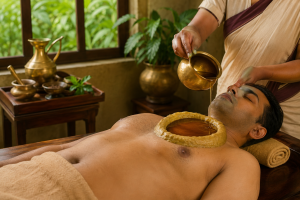
A proper Nasya is gentle, not dramatic, and the preparation is half the treatment. We start with a warm facial and head massage (Snehana) followed by localised steam (Swedana) over the face and forehead. That loosens the Kapha first. Then warm medicated oil is instilled into each nostril while you lie back with the head slightly extended, and you rest, breathe it in, and spit out what drains into the throat.
Where do we have an edge? In the oil itself, and the setting. Founded in 2010, our 18-acre campus in Udupi district grows more than 150 medicinal plants, and the Nasya oils come fresh from our own pharmacy rather than off a shelf. Patients usually take a short course of sessions across several days, paired with diet adjustments and steam, in clean coastal Karnataka air that's kinder to inflamed airways than a dusty city. You can see the wider range of Panchakarma procedures we offer on our treatments page.

Is Nasya safe, and can you do it at home?
For most people, supervised Nasya is very safe and well tolerated. The gentle daily form, Pratimarsha Nasya with a couple of drops of a suitable oil, can be taught for home use as upkeep. The therapeutic form is different, and it shouldn't be improvised from a video.
A few cautions. Avoid Nasya during an acute infection with fever, right after meals, during pregnancy, or immediately after a bath. If you have a structural problem like a badly deviated septum, recurring bleeds, or symptoms that aren't improving, get it checked by an ENT doctor too. Nasya complements that care; it doesn't replace investigation of a persistent problem.
The sensible approach is to get assessed once, learn the home routine if it suits you, and reserve the therapeutic course for when congestion is genuinely chronic. Done that way, Nasya is one of the lowest-risk, highest-comfort therapies Ayurveda offers.
Frequently asked questions
How many Nasya sessions will I need for sinusitis?
It depends on how chronic the problem is. A therapeutic course usually runs 7 to 14 days, and a trial combining Anu Taila Nasya with herbal steam reported 96.6% clinical efficacy over a structured course. Many patients then continue gentle daily Pratimarsha Nasya at home to hold the gains.
Does Nasya hurt, or feel uncomfortable?
No. After the warm massage and steam, the oil instillation feels mild, and most people find the whole session relaxing. You may taste the oil at the back of the throat and clear some mucus afterward, which is the therapy doing its job, not a side effect to worry about.
Can Nasya help allergic rhinitis and dust allergies?
Yes, it's one of its main uses. Allergic rhinitis affects close to 1 in 10 Indian adults, and Nasya calms the over-reactive nasal lining while clearing Kapha. Paired with diet changes and seasonal routines, it can reduce how often and how hard you react to dust and pollen.
Will my sinus problem come back after treatment?
It can, if the triggers return and nothing changes. That's why we pair Nasya with diet, daily home Nasya and seasonal care. Sinusitis is closely tied to Kapha and damp weather, so a pre-monsoon routine and a few lasting habits make recurrence far less likely than one-off treatment alone.
Is Nasya safe for children?
Gentle Nasya can suit older children under guidance, with milder oils and smaller doses, and it's sometimes used for recurrent colds and blocked noses. It isn't given to very young children casually. Always have a qualified practitioner assess the child first, and keep your paediatrician in the loop.
The bottom line
Sinus problems rarely fix themselves with one more course of antibiotics. Nasya takes a different route, literally, treating the sinuses and head through the nose, clearing the Kapha that keeps the trouble coming back.
- Allergic and sinus disorders affect 20 to 30% of Indians, and about 40% of rhinitis cases progress to asthma.
- Ayurveda treats chronic sinusitis as Dushta Pratishyaya, a Kapha-driven disorder of the head's channels.
- Anu Taila Nasya cut nasal obstruction by roughly 35% in a four-week trial.
- It pairs well with ENT care and works best alongside diet and seasonal routines.
Tired of the blocked nose and the recurring headaches? A short assessment will tell you whether Nasya fits your case. Book a consultation with Chithrakoota Ayurveda, or call +91-9480011578 / message us on WhatsApp, and we'll map out a realistic plan for clearer breathing.
Medical disclaimer: This article is for general education and isn't a substitute for personalised medical advice. A blocked nose or facial pain that persists, worsens, or comes with high fever or vision changes needs prompt medical assessment. Always consult a qualified Ayurvedic physician before starting Nasya or any Panchakarma therapy.
About the authors: This article was written by Dr. Rajesh Bayari (BAMS), Chief Physician and co-founder of Chithrakoota Ayurveda, and medically reviewed by Dr. Anulekha Bayari (BAMS), Physician and co-founder. Dr. Rajesh holds his BAMS from ALN Rao Memorial Ayurvedic Medical College, Koppa, and together they have run Chithrakoota, an 18-acre Ayurvedic treatment centre in Udupi district, Karnataka, since 2010.